Ringling Museum of Art Grounds and Circus Sarasota Florida
Last Updated on March 22, 2022 by

Estimated reading time: 13 minutes
By Jim Ferri
There are many adept places to visit in Florida beyond Orlando, Southward Beach, and Key West.

Ane is the Ringling Museum, the 66-acre estate of John and Mable Ringling. Ringling was the famous circus impresario of the early 20th century.
The manor is an incredible complex that includes three museums and magnificent gardens.
Located on the Gulf of Mexico in Sarasota, Florida, information technology'south a 2 ½-hr bulldoze from Orlando and iii ½ hours from Miami. Information technology'south well worth the drive.
In brief, when I visited I expected a museum like then many others I've visited. Instead, I found i of the finest museums and museum complexes I've seen anywhere. And despite the founder'southward proper noun, this museum is anything but a circus.

Consider this: Sotheby'south, the globe-renowned art appraisers, rates the museum's art collection similar to that of London's Victoria and Albert Museum, Amsterdam's Museum Van Loon, and Delaware's Winterthur Museum, Garden and Library. It's but that expert, in fact, it's over-the-top.
Upon his death, Ringling bequeathed the museum to the people of Florida. Consequently, it's now the official State Fine art Museum. In addition, the entire estate is on the National Register of Historic Places.
Ringling, a wealthy man, enjoyed fine art and travel and made many trips to Europe, particularly Italian republic, with his married woman, Mable. Undoubtedly, they were corking tourists of their time equally they wandered the Continent purchasing art for their collection. On those trips, Ringling also had copies made of classical sculptures, at present part of the museum'southward collection, which he envisioned every bit a component of an fine art school he planned to build on the estate.

The Ringling Museum: An Incredible Estate
The focus bespeak of the estate, and so evident when you enter, is the palatial and celebrated Ringling business firm, Ca d'Zan. Its name ways "House of John" in the erstwhile dialect of their beloved Venice. Designed to resemble a Venetian Gothic palace, it looks as if it could take been plucked right out of a Great Gatsby-era movie.
Not surprisingly, it's a vast house, 36,000 foursquare feet in size and five stories tall. There are 56 rooms, 15 bathrooms, and an 81-foot Belvedere tower. A attestation to the Roaring Twenties, it contains everything one could want to alivereally well during that epoch.

The opulent firm is also filled with beautiful art and tapestries, Venetian furniture, marble floors, and stained-glass ceilings with crystal chandeliers. In fact, the living-room chandelier was bought past Ringling from the original Waldorf-Astoria hotel in New York Metropolis.

The main room of Ca d'Zan, called "the court," was the focal point for the Ringling'due south entertaining. One can't help but admire both its size and splendor. In one corner is a beautiful inlaid desk. Across from the grand fireplace is a lovely Aeolian organ, tapestries and paintings of Ringling and Mable.
The Tap Room made me experience like I was in a small bar tucked abroad somewhere in Venice. Backside the bar are stained glass and painted panels, crowned with, of all things, the horns of a longhorn steer.
Appropriately, like everything else in the business firm, Ca d'Zan's beautiful terrace is broad and striking. Overlooking Sarasota Bay, information technology has stained-glass doors that open onto it from the firm.
Gardens of The Ringling Museum
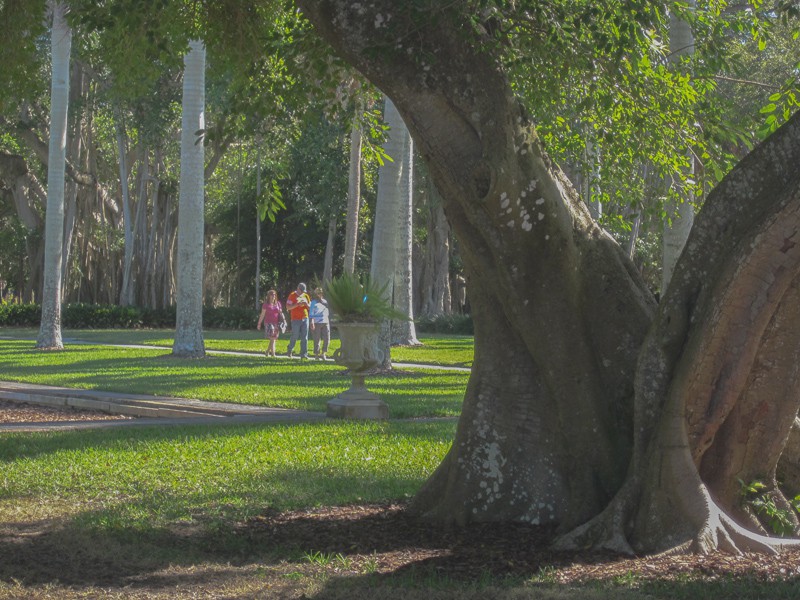
The Ringling Museum's grounds and gardens are as treasured as the incredible artworks in the museum.
The firm and museums are in the Bayfront Gardens, home to thousands of trees and plants gracing a beautiful park-similar setting. Moreover, its manicured lawns, with massive oaks trimmed with Castilian moss, provide a sense of luxury you'll observe in very few other places.
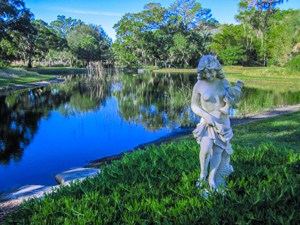
It's all the upshot of Mable desiring an manor with exotic trees and plants. In fact, she collected plants with the same fervor her husband collected art.
Today there are more than 2350 trees on the grounds of the magnificent estate, representing an array of native, exotic, historical, and culturally significant species.
There are also several meaning gardens.
Mable'due south 27,225 square foot Rose Garden was beginning planted in 1913, years before Ca d'Zan was built. It contains more 400 varieties of roses on more than 1,000 bushes. You'll find statues tucked away on winding paths throughout the Italian-inspired garden. The all-time time to encounter it bloom is approximately six weeks after its annual cutback each February and October.
In the whimsical Dwarf Garden you'll see amusing stone statues that John Ringling had brought from Italia. Information technology'due south reminiscent of romantic 18th- and 19th-century German language and Italian gardens.
Mable'due south Secret Garden is n of Ca d'Zan, which contains the burying site of she and John, and his sister Ida Ringling North.
John and Mable Ringling Museum of Art
Undoubtedly, the most famous edifice on the property is the John and Mable Ringling Museum of Art. Information technology's a beautiful, pink-colored Renaissance-style building, built equally a U-shaped palace enclosing a courtyard. Moreover, the statues above the entrance give it a regal look.
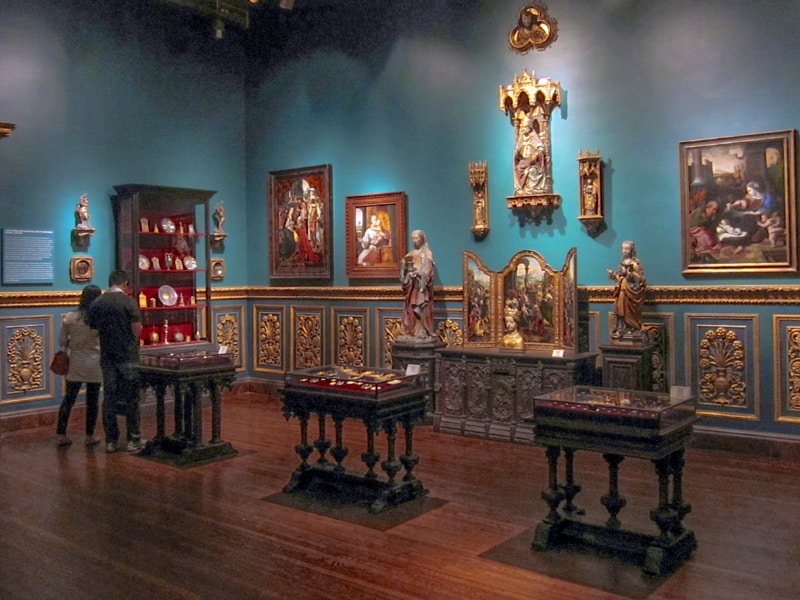
Ringling filled it with European art and the paneled rooms from the Gilded Historic period Astor mansion in New York. He also purchased ancient and medieval objects from distinguished collections worldwide to include in information technology.

When opened by Ringling in 1930, the museum had only ane gallery. Today it has 21, filled with important works past Peter Paul Rubens, Anthony van Dyck, Diego Velázquez, Titian, Tintoretto, Paolo Veronese, El Greco, and Thomas Gainsborough.
Equally a showman, Ringling provided big and bold entertainment. Some surmise that is why he was fatigued to Rubens, who painted large and bold Baroque canvases.
In fact, on his European jaunts, Ringling gathered a signature collection of Ruben's works for his museum. it includes five of the seven paintings of the artist's "Triumph of the Eucharist"series. While the paintings are spectacular, viewing these massive paintings together in the museum can be a bit overwhelming to some.
Accordingly, all the private museum rooms of the Ringling are painted in unlike shades to best befit the works they contain. Moreover, several galleries are spectacular 19th-century rooms with ornate woodwork. They provide a stunning venue for all the art treasures collected by Ringling. The entire drove ranges from belatedly medieval European fine art, through 16th- and 17th-century Italian masterpieces, to 18th-century American works.
Although Ringling mainly acquired European pieces for his art collection, he purchased Cypriot art at the beginning of his European art forays, and Asian treasures before his expiry in 1936.

The Ringling Museum Today
The newest addition to the Ringling Museum of Art is the twenty,000-foursquare-foot Center for Asian Art. It now connects the European galleries with those that are home to Chinese, Japanese, and Indian artworks. The collection includes a 10th-century Buddha and Chinese ceramics from all periods of history. The works range from aboriginal to avant-garde.
The museum also has a collection of x,000 photographs, which are put on showroom on a rotating schedule. The museum also hosts special exhibitions borrowed from such institutions as The Walter's Fine art Museum in Baltimore, Boston's Museum of Fine Arts, and Nashville'southward Frist Heart for the Visual Arts.

What sets the John and Mable Ringling Museum of Art autonomously from many other museums is that information technology's non just a identify to admire the art merely larn about it. In some galleries, there are guide-sheets, from which you'll get a better understanding of what you're viewing.
For example, in Gallery 15,The Art of France, 1700 – 1800, I read about rococo painting, which I knew cypher almost. Then I was fatigued over to a beautiful 1652 harpsichord that had been hand carved and painted in gilded woods. In another gallery, I learned mostCapriccio, the paintings of imaginary landscapes containing elaborate architectural structures.
It's an intimate place that gives the feeling that y'all're wandering through someone's home admiring their private collection. In fact, it were in Europe, Americans would likely charge per unit it equally a "must-run into," and people would line up waiting to get in.

The Cute Inner Courtyard
Without uncertainty, ane of the almost beautiful parts of the John and Mable Ringling Museum of Art is its inner courtyard, filled with Greco-Roman statuary and casts of classical works. The most famous is Michelangelo's David, a 17-foot alpine, 5 ½ ton bronze replica of the famous statue in Florence's Galleria dell'Accademia.

I sat downwards on a demote in the rose-colored pillar and looked across the backyard at the pools, fountains, and statuary lining the roof. Brightly colored bougainvillea cascaded out of huge terra-cotta pots, with the breeze billowy their fallen petals along the walkways.
Afterwards, while wandering most, I encountered the statue of a nymph continuing in a little foursquare of juniper bushes. A lilliputian Cupid peeked out from a pedestal in the bushes not far beyond. I felt every bit if I was strolling through the courtyard of a 500-twelvemonth-old Italian palazzo.
Consequently, it fabricated for a perfect morn in a magnificent little museum, which you lot'll probable relish visiting if yous always have the opportunity.
The Ringling Circus Museum
The Ringling Circus Museum is, in fact, two separate museums. The first contains circus wagons and Ringling's opulent restored rail machine (Ringling'southward 79-foot-long car "The Wisconsin," has viii rooms, including three bedrooms, a kitchen and bathroom with a bathtub – golden plating, and beautiful stained-glass windows.)

There'due south too the ticket booth, mechanic's cart (containing everything to go on the testify going), animal cars for the sideshows, and many other memorabilia.
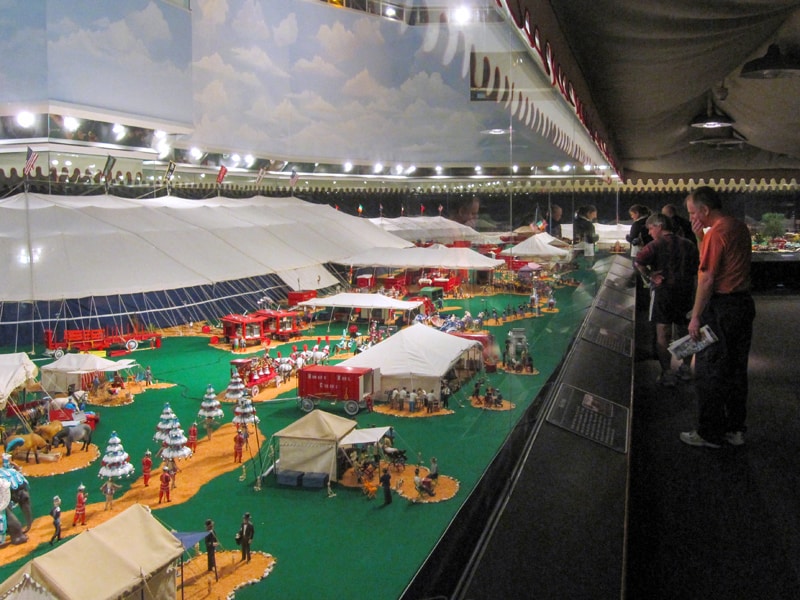
But the museum's star is the Tibbals Learning Eye. Information technology contains an incredible miniature recreation of the "Howard Bros. Circus," patterned subsequently Ringling'south extravaganza.
Its meg pieces are built to exact scale (3/4″ to the foot). For case, there are 7,000 miniature-folding chairs and when folded, fit into the five niggling wagons, just as in the actual show. Amazingly, one man, Howard Tibbals, created it over 55 years.
It's fascinating and shows the circus, from when the train pulls into town to when the big prove is over. It covers an area of 3,800 square anxiety and is near 1½ times the length of a football field.

As you wander forth, you hear sounds associated with each issue y'all're passing … elephants bellowing, people cheering, grunts, groans, music. Plaques explain what you're viewing.
As I read one of the plaques, lights dimmed, and tiny lights twinkled within the tent, starting the night show. Down to the correct, I saw a miniature policeman grabbing boys sneaking in under the side of the tent. Information technology is correct downward to the smallest detail and incredibly fascinating.
Too, go upwardly to the second floor. You'll find an exhibit that details circus history from ancient times. Yous won't want to miss this either.

The Historic Asolo Theater
Now function of the Ringling Museum circuitous, the Historic Asolo Theater is a "jewel box" of a theater.
It was congenital in 1798 in Asolo, Italy, a town in the Veneto Region of Northern Italy. There it originally occupied the great hall of a Renaissance Palace built for the exiled Queen of Republic of cyprus.
The Ringling acquired it in 1949, brought information technology to Sarasota, and installed it in a gallery of the Museum of Fine art. Subsequently falling into disrepair in the belatedly 20th century, the theater was conserved and restored and moved to the new Visitors Pavilion. Today, information technology serves equally a performing arts venue featuring drama, dance, music, and film.
If You Go:
The John and Mable Ringling Museum of Art
5401 Bay Shore Road
Sarasota, Florida 34243
http://www.ringling.org/
Tel: (941) 359-5700
Open: daily 10:00am-5:00pm / closed on Thanksgiving, Christmas, and New Years Twenty-four hours
Admission: Since prices vary depending on which role of the estate yous are visiting, see the access policy here.
Dining at the Ringling
The Ringling Grillroom
Located in the John M. McKay Visitors Pavilion
https://www.theringlinggrillroom.com
Tel: 941-360-7390
Open daily 11:00am – 7:00pm
Note: View the Carte
Mable's Coffee and Tea
Located upstairs in the John Thou. McKay Visitors Pavilion
Serves Starbucks hot and cold beverages and fresh fabricated salads, sandwiches, and parfaits and broiled goods.
Open up: 10am – 5pm daily
The Wandering Chef Nutrient Truck
Serves picnic and child-friendly foods.
Parked near the Banyan Café daily, ten:30am – 3:00pm
Picnics
Picnic tables located in the Dwarf Garden and the Playspace. Picnic coolers are allowed in designated picnic areas during regular business hours.
Source: https://www.neverstoptraveling.com/ringling-museum
0 Response to "Ringling Museum of Art Grounds and Circus Sarasota Florida"
Postar um comentário